
Upgrading the flooring in your Dubai property is one of the most impactful investments you can make. Whether you are a villa owner in Dubai Marina renovating for a modern aesthetic, a commercial property manager upgrading an office in Business Bay, or a real estate investor preparing an apartment for premium rent, choosing Stone Plastic Composite (SPC) flooring is an incredibly smart move.
Many property owners assume that because SPC is tough, it can be thrown down over any surface. This oversight often results in costly rework, buckling floors, and voided warranties. This complete SPC Flooring Installation Dubai guide highlights the most critical, real-world mistakes to avoid before and during your installation project to ensure your floors last for decades.
Ignoring Subfloor Preparation: The #1 Cause of Floor Failure
The biggest misconception about SPC flooring is that its rigid core can completely mask an uneven subfloor. While it bridges minor imperfections better than traditional flexible luxury vinyl tiles (LVT), it is not a magic fix for a bumpy or sloped subfloor.
The Mistake
Installing SPC planks directly over un-leveled sand-cement screed, damaged ceramic tiles, or cracked concrete.
The Consequence
SPC flooring relies on a click-lock tongue-and-groove system. If there is a hollow space or a high bump under a plank, walking on that area puts immense vertical pressure on the joint. Over time, the locking mechanisms will crack, causing the planks to separate, creak, or bounce underfoot. Investing in premium materials from a trusted SPC Flooring Dubai specialist can offer better initial joint strength, but even the best planks will eventually fail if your subfloor is uneven.
How to Avoid It
- The 3mm Rule: Use a straightedge or spirit level to check the subfloor. Any deviation greater than 3mm over a 2-meter radius must be corrected.
- Grind and Fill: High spots must be mechanically ground down. Low spots and cracks must be repaired using a high-quality self-leveling underlayment compound.
- Cleanliness: Ensure the subfloor is completely free of dust, plaster drops, paint spills, and grease before laying the planks.
Neglecting Dubai Moisture & Acclimatization Realities
Dubai’s coastal desert climate creates massive atmospheric swings between intense outdoor heat and chilly, air-conditioned interiors.
The Mistake
Rushing the installation the same day the material is delivered, or failing to test the subfloor moisture content in newly built villas and commercial spaces.
The Consequence
Even though SPC itself is waterproof, concrete screeds release moisture as they cure. If you trap moisture beneath the non-porous SPC planks, hydrostatic pressure builds up. This leads to mold, unpleasant odors, and warping issues. Furthermore, if the planks are stored in a hot warehouse or truck and then immediately installed in a cold, AC-cooled room, they will rapidly contract, snapping the locking profiles or leaving wide gaps.
How to Avoid It
- Acclimatize the Material: Store the unopened boxes flat in the room where they will be installed for a minimum of 48 hours. Ensure the room’s air conditioning is running at its normal, everyday operational temperature (typically between 20°C and 24°C).
- Moisture Testing: Ensure the subfloor moisture vapor emission rate is within the manufacturer’s limits (usually below 3% moisture content for concrete screeds).
- Install a Vapor Barrier: Always use a minimum 6 mil (0.15mm) polyethylene moisture barrier underlayment over concrete subfloors to isolate your flooring from rising dampness.
Omitting Expansion Gaps Around the Perimeter
Because SPC stands for Stone Plastic Composite, people assume it behaves like stone and does not expand or contract. This is a critical misconception.
The Mistake
Fitting the SPC planks flush against walls, door frames, kitchen cabinetry, or heavy structural pillars.
The Consequence
While the stone dust core provides excellent dimensional stability, the plastic polymers within the composition still react to temperature shifts. When summer temperatures spike or AC units are turned off while owners travel abroad, the floor will expand. If it has no room to stretch, the planks will bind against the walls and push upward against each other, creating dramatic “peaking” or buckling ridges across your room.
How to Avoid It
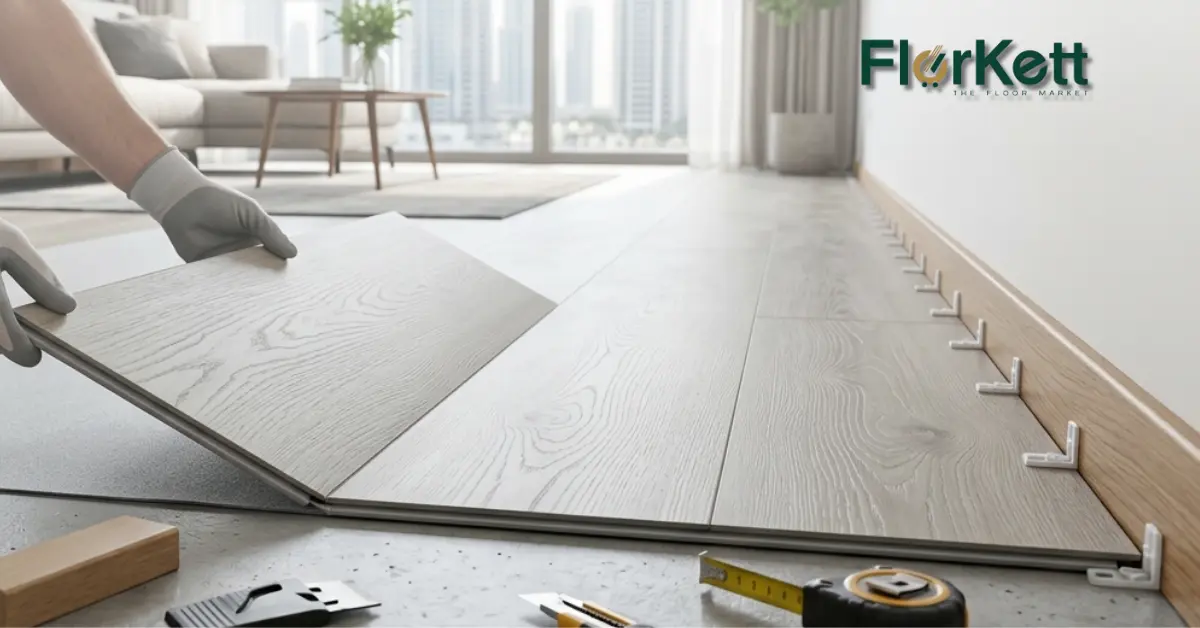
- The Perimeter Rule: Always leave a uniform 8mm to 10mm empty gap between your first/last planks and the structural wall. This acts as a hidden safety zone.
- Use Spacers: Utilize dedicated plastic spacers during fitting to keep this gap perfectly uniform across the room.
- Conceal Safely: Your skirting boards or wall moldings will sit right on top of this space, fully hiding the gap from view while allowing your new floor to expand safely underneath. Crucially, fix the skirting to the wall, never to the floor itself, allowing the floor to float freely beneath it.
Poor Layout Planning and Staggering Shortfalls
A beautiful floor is defined by its symmetry and structural layout. A chaotic or poorly planned layout instantly diminishes the premium feel of high-end interiors.
The Mistake
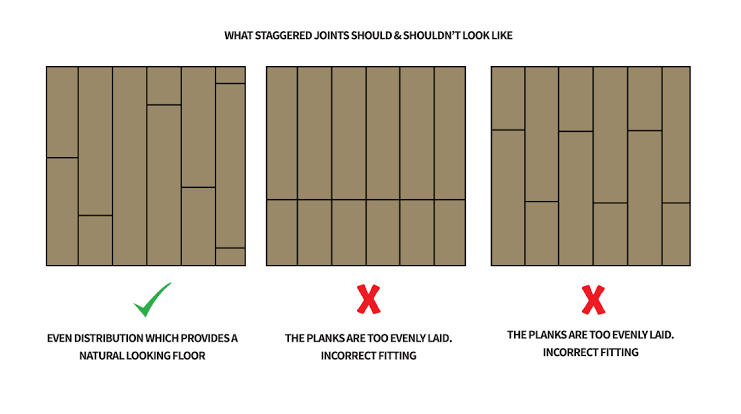
Failing to measure the room’s width before starting leads to tiny, weak slivers of planks at the far wall. Another common error is “H-joints” or “stair-step” patterns, where the short end joints of the planks align too closely in adjacent rows.
The Consequence
Tiny plank cutouts under 5cm wide are highly unstable and incredibly difficult to click together securely. Poorly staggered joints fail to properly distribute structural loads across the floor, making the entire installation weaker and visually unappealing.
How to Avoid It
- Calculate the Last Row: Measure the room width and divide by the width of a single plank. If the remaining fraction is less than 5cm, trim your very first starting row down to balance out the room.
- Stagger Joints Correctly: Ensure the short-end joints of planks in adjacent rows are offset by at least 20cm to 30cm. This creates a strong, interlocking matrix that holds up perfectly under heavy foot traffic.
The Simple Rule: The “Step” Method
To make the floor strong, you want the seams to look like steps, never a straight line. Here is exactly how a professional installer cuts them:
Falling for Cheap Underlayment or Subpar Material Grades
When computing your overall SPC flooring installation Dubai cost, it is incredibly tempting to cut corners on the elements you cannot see once the job is finished.
The Mistake
Using an underlayment that is too soft or thick (like cheap packing foam), or choosing a residential-grade SPC plank with a thin wear layer for a high-traffic commercial asset or busy family home.
The Consequence
If the underlayment underneath your rigid SPC is too spongy or exceeds 2mm to 3mm in thickness, it creates excessive vertical movement every time you step on the floor. This deflection easily breaks the brittle click-lock joints. Choosing a subpar wear layer also means your floor will show scratches, scuffs, and fading within just a few years of heavy use.
How to Avoid It
- Pick the Right Underlayment: Use high-density IXPE or EVA foam underlayments specifically rated for rigid core flooring, ideally capped at 1.5mm to 2mm thickness. Many premium SPC products now come with pre-attached IXPE backing, eliminating this guesswork.
- Check the Wear Layer: For residential properties, choose a wear layer of at least 0.3mm. For commercial spaces, offices, retail spaces, or high-traffic rental properties, insist on a 0.55mm wear layer or higher.
The Ultimate Pre-Installation Checklist for Dubai Properties
Before you allow your installation crew to lay down a single plank, review this checklist to prevent unexpected delays and hidden expenses.
✅ AC Operational: Is the indoor HVAC system running at a stable 21°C–23°C? Has the material acclimatized inside the space for 48 hours?
✅ Subfloor Flatness Checked: Has the floor been checked with a spirit level to ensure deviations are well under 3mm?
✅ Moisture & Curing Verified: If dealing with new screed, has it cured completely (typically 1 week per cm of thickness) and passed a moisture check?
✅ Perimeter Expansion Calculated: Do you have enough matching skirting or T-molds to cover the mandatory 8mm–10mm expansion gaps?
✅ Doors Trimmed: Have you checked if the new floor height (plank + underlayment) clears your existing internal doors? (Trimming wooden doors beforehand prevents post-install scratches.
Partner with Professionals for Lasting Results
Avoiding these common pitfalls saves you time, stress, and thousands of dirhams in long-term repairs. If you are looking to purchase premium materials or need specialized support for your next project, it is wise to consult reputable flooring specialists. Partnering with elite SPC Flooring Dubai experts ensures your materials are perfectly adapted to regional climates.
Furthermore, checking out established Flooring Companies in Dubai can connect you with certified installation crews who understand local construction standards and provide rock-solid warranties on their craftsmanship. Take your time with the preparation phases; a flawless, durable floor is always built from the ground up!
Frequently Asked Questions
Can I install SPC flooring directly over my existing ceramic tiles in Dubai?
Yes. You can install it directly over old ceramic tiles if they are flat, stable, and firmly bonded. However, if your grout lines are wider than 4mm or deeper than 2mm, they must be filled with a patching compound first to prevent the lines from showing through your new floor over time.
Why is my newly installed SPC floor making clicking or creaking noises?
Uneven subfloors or missing wall expansion gaps. When a floor lacks perimeter gaps, temperature changes cause the expanding planks to jam against walls. Walking on the floor releases this trapped tension, causing the tight click-lock joints to rub together and creak underfoot.
How much does a professional SPC flooring fitting in Dubai typically cost?
AED 15 to AED 35 per square meter for labor. The exact SPC flooring installation cost in Dubai depends on layout complexity and subfloor leveling needs. If you combine premium materials with the SPC flooring fitting Dubai service, the total all-inclusive price generally ranges from AED 65 to AED 125 per square meter.