
Selecting the right commercial flooring in the United Arab Emirates involves balancing aesthetic appeal, heavy foot traffic durability, and environmental responsibility. As green building mandates like LEED certification and the Dubai Green Building Regulations become standard across corporate developments, interior designers and project managers are shifting away from traditional broadloom carpets. Instead, sustainable modular flooring solutions have emerged as the preferred choice for forward-thinking enterprises.
Modern modular flooring provides an ideal combination of longevity, design flexibility, and low environmental impact. Using eco-conscious options helps corporate spaces drastically reduce material waste, improve indoor air quality, and lower long-term maintenance costs. This comprehensive guide explores how specifying the right modular flooring transforms workspaces into healthy, high-performing, and sustainable commercial interiors.
Why Carpet Tiles Are the Green Standard for Dubai Offices
Question: How do modular flooring options minimize environmental impact during corporate fit-outs?
Answer: High-performance Carpet Tiles Dubai serve as the green standard for local commercial interiors by minimizing installation material waste, utilizing recycled content, and lowering carbon footprints during transport. Their modular design allows facilities managers to replace only damaged sections rather than entire floors, drastically extending the interior’s lifespan.
The Environmental Toll of Traditional Commercial Flooring
Traditional roll carpets present significant waste challenges in corporate fit-outs. Fitting a standard broadloom carpet into a complex office layout with corridors, alcoves, and pillars results in an average of 15% to 20% material waste. This excess material usually ends up in local landfills because it is bonded to multi-layered backing systems that are difficult to separate and recycle.
Furthermore, if a single area suffers a permanent chemical stain or severe wear from rolling office chairs, the entire room’s carpet often must be ripped out and replaced. This creates an unsustainable cycle of consumption and disposal that conflicts with modern corporate environmental goals and regional sustainability frameworks.
The Modular Efficiency of Carpet Tiles
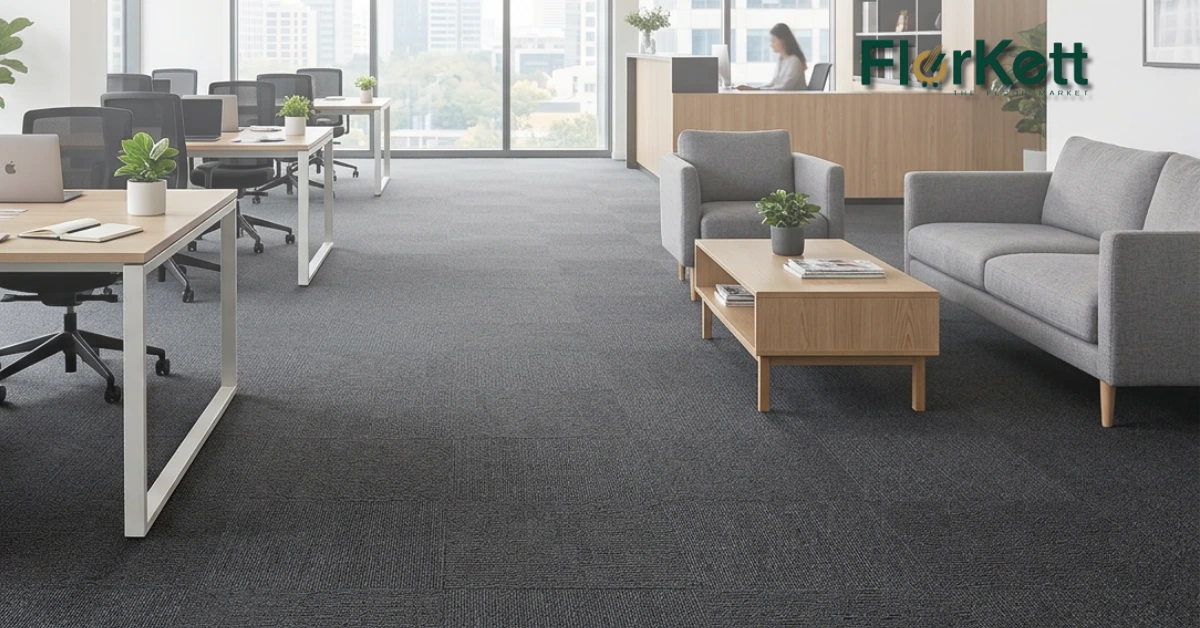
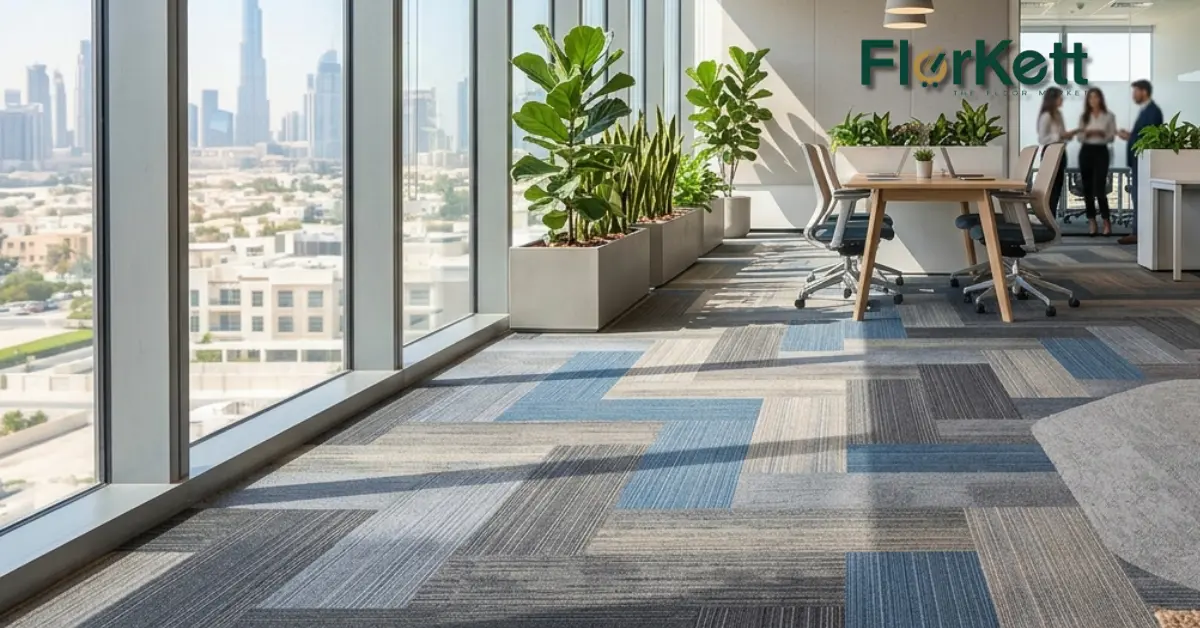
Modular flooring solves this waste problem through geometric efficiency. Because they are typically supplied in precise square sizes (such as 50×50 cm or plank formats), installation waste drops to less than 3% to 5%. The tiles can be arranged strategically to fit any floor plate without extensive cutting.
The true environmental benefit, however, is realized during the operational maintenance phase. If an employee spills coffee or damages a section of the floor, only those specific tiles need to be removed and replaced. The rest of the floor remains intact, saving corporate clients thousands of dirhams while keeping perfectly functional textiles out of the waste stream.
Material Matters: Eco-Friendly Backings and Recycled Fibers
Question: What eco-friendly materials should buyers look for when sourcing commercial modular flooring?
Answer: Eco-friendly carpet tiles prioritize sustainability by incorporating regenerated nylon fibers and bio-based or recycled PVC-free backings. Selecting these advanced materials reduces reliance on virgin petroleum products, traps fewer volatile organic compounds (VOCs), and ensures the flooring can be recycled at the end of its life cycle.
Understanding Regenerated Nylon
In our experience overseeing commercial interior projects across the region, the choice of face fiber dictates both the durability and the environmental footprint of the floor. Leading global manufacturers now utilize 100% regenerated nylon yarns, such as Econyl, which are sourced from reclaimed fishing nets, abandoned carpets, and industrial plastic waste.
This nylon performs identically to virgin nylon 6,6, offering the same resilience against crushing under heavy rolling office chairs and high foot traffic. However, its production consumes significantly less water and generates a fraction of the carbon emissions compared to manufacturing traditional synthetic polymers. It can also be recycled infinitely without losing its material purity.
The Importance of Low-VOC, Sustainable Backings
The backing of a tile gives it structural stability, weight, and acoustic properties. Historically, manufacturers relied on heavy fiberglass or modified bitumen backings that contained harmful plastic chemicals and off-gassed volatile organic compounds (VOCs) into the workplace, degrading indoor air quality.
For a healthy and sustainable workplace, look for tiles engineered with cushion backings made from recycled polyethylene terephthalate (PET) plastic bottles. These backings enhance underfoot comfort for employees standing for long periods, provide superior acoustic dampening in open-plan offices, and emit zero VOCs. This contributes to healthier indoor air quality and helps projects earn valuable credits toward green building certifications.
The Economics of Sustainability: Life Cycle Cost Analysis
Question: How do sustainable modular carpets compare financially to lower-cost flooring options over time?
Answer: While the initial carpet tiles Dubai price can vary based on material quality, their long-term cost-efficiency far surpasses cheaper options. A comprehensive life cycle analysis shows that reduced installation waste, lower cleaning costs, and targeted tile replacement deliver a lower total cost of ownership over ten years.
Initial Purchase vs. Total Cost of Ownership
When procurement teams evaluate flooring options, they often focus solely on the upfront cost per square meter. It is a common mistake to choose low-grade alternatives simply to meet an immediate fit-out budget.
Cheap, non-commercial-grade options, such as some generic carpet tiles that Dragon Mart suppliers offer, may work well for temporary exhibitions or low-use residential spaces. However, they frequently lack the structural density and heavy contract wear ratings required for corporate headquarters. Within 24 months, low-quality options often suffer from edge-curling, fading, and delamination, forcing an early replacement that negates any initial savings.
Comparative Commercial Flooring Financial Analysis
To understand the financial benefits over time, consider this ten-year cost projection for a 1,000-square-meter corporate office space:
| Financial Element | Premium Sustainable Carpet Tiles | Standard Broadloom Carpet | Low-Cost Economy Tiles |
| Average Supply Cost (AED/m²) | AED 85 – AED 140 | AED 60 – AED 95 | AED 35 – AED 55 |
| Installation Waste Factor | 3% – 5% | 15% – 20% | 5% – 8% |
| Expected Lifespan | 10 – 15 Years | 5 – 7 Years | 2 – 3 Years |
| 10-Year Replacement Frequency | 0 Times | 1 Time | 3 Times |
| Total 10-Year Cost (inc. labor) | Low | Medium-High | Very High |
Investing in high-performance modular flooring results in lower lifetime costs. The durability of premium commercial tiles eliminates the operational disruption, secondary labor costs, and disposal fees associated with frequent flooring renovations.
Selecting the Right Installation Method: Adhesives vs. Floating Floors
Question: What is the most environmentally responsible installation method for commercial carpet tiles?
Answer: Sustainable installation relies on low-VOC, pressure-sensitive adhesives or glueless connector systems that eliminate airborne toxins. Avoiding high-chemical wet glues simplifies eventual tile removal, protects the subfloor, and ensures the carpet tiles can be cleanly recycled without heavy chemical contamination.
The Hazards of Standard Liquid Glues
The method used to secure flooring to the concrete screed plays a significant role in indoor environmental quality. Traditional liquid glue releases large amounts of chemical vapors during application, which can linger in air conditioning systems for weeks.
Furthermore, permanent wet glues bond aggressively to both the subfloor and the tile backing. When it comes time to remodel, the tiles must be scraped up in pieces, leaving a ruined subfloor covered in adhesive residue and making the carpet material impossible to recycle.
Glueless Connectors and Pressure-Sensitive Adhesives
One recommendation we often give clients aiming for green building certifications is to use glueless tac-tiles or connector squares. These are small, double-sided adhesive patches placed underneath the corners where four tiles meet. This creates a “floating floor” system where the tiles are securely locked to one another but do not adhere directly to the concrete slab.
If your layout requires a full-surface adhesive, ensure your installer selects a specialized, low-VOC pressure-sensitive adhesive. This adhesive retains a tacky, tape-like consistency indefinitely, allowing tiles to be lifted cleanly and replaced easily without damaging the underlying subfloor.
Sourcing and Procurement: Navigating the Market Safely
Question: How can commercial buyers locate authentic, sustainable modular flooring products in the region?
Answer: Commercial buyers should partner with verified Flooring Companies in Dubai that provide transparent environmental product declarations (EPDs). It is critical to differentiate heavy-duty commercial materials from light-duty solutions, such as self-adhesive carpet tiles, in Sharjah retail outlets targeting residential use.
Matching Product Specifications to Space Requirements
The regional flooring market offers a wide variety of choices, ranging from high-end European imports to budget-friendly regional options. To secure a solution that meets your corporate sustainability goals, your procurement team should work closely with established suppliers that can provide verifiable environmental data sheets and third-party certifications.
Avoid using consumer-grade alternatives for high-traffic office spaces. For example, the self-adhesive carpet tiles offered by Sharjah retailers are often designed for light residential use or quick DIY home projects. These peel-and-stick tiles rarely feature the heavy-duty nylon wear layer or the stable, multi-layered backing needed to withstand heavy office traffic, rolling furniture, and frequent commercial cleaning.
Key Procurement Checklist for Commercial Buyers
Before signing a procurement contract, confirm that your chosen supplier provides documentation for the following criteria:
- Cradle to Cradle Certification: Verifies that the product is evaluated for human and environmental health throughout its entire life cycle.
- CRI Green Label Plus: Assures that the flooring emits very low levels of VOCs, protecting indoor air quality.
- Heavy Contract Rating (Class 33): Guarantees the tiles are certified for intense daily use in corporate corridors, open work areas, and conference rooms.
- Acoustic Insulation Rating: Look for products providing at least 24dB to 30dB of impact sound reduction to maintain a quiet, productive office environment.
Long-Term Maintenance and Preservation Strategies
Question: What maintenance routine is required to maximize the lifespan of sustainable carpet tiles?
Answer: Maximizing carpet tile longevity requires a proactive maintenance routine consisting of daily dry vacuuming with a dual-motor pile lifter, prompt low-moisture spot cleaning, and annual encapsulation extraction cleaning. This prevents abrasive dirt from degrading fibers while minimizing water and chemical usage.
Proactive Dirt Prevention
The most effective way to extend the lifespan of your commercial flooring is to stop dirt from entering the premises entirely. Implementing a high-performance entrance matting system at all exterior entry points captures up to 80% of the soil, sand, and moisture tracked in by employees and visitors.
Sand particles act like tiny razor blades under pressure, cutting through nylon fibers and causing premature wear. Protecting high-traffic transition zones preserves the texture and appearance of the main office carpet tiles for years.
Eco-Friendly Cleaning Methodologies
When cleaning becomes necessary, avoid traditional wet shampooing methods that saturate the carpet backing with excess water. Excessive moisture creates a breeding ground for mold and mildew within the flooring layers, destroying indoor air quality and ruining the subfloor adhesive.
Instead, instruct your facilities management team to use low-moisture encapsulation cleaning. This process applies a specialized biodegradable polymer solution that binds to dirt particles, crystallizing them into microscopic beads that are easily removed during the next scheduled vacuuming. This method uses 90% less water, allows the floor to dry in under an hour, and leaves no sticky chemical residues that attract fresh soil.
Frequently Asked Questions About Commercial Carpet Tiles
How long do commercial carpet tiles typically last?
High-quality, contract-rated commercial carpet tiles with a nylon 6,6 or Econyl face fiber generally last between 10 and 15 years in a standard office environment. Their lifespan can be extended even further by rotating tiles from low-traffic perimeter areas into high-traffic corridors when localized wear begins to show.
Can carpet tiles be installed over existing hard flooring?
Yes, provided the existing hard flooring is structurally sound, perfectly level, dry, and free of cracks or loose fragments. Installing over ceramic tiles or smooth vinyl using a pressure-sensitive adhesive or glueless connectors is an excellent way to renovate a space quickly without the environmental disruption and dust of removing the old floor.
What should I look for regarding fire safety compliance?
For commercial office environments in the UAE, flooring must meet strict civil defense fire safety standards. Ensure the carpet tiles carry a Class Bfl-s1 fire rating according to European standards (EN 13501-1) or a Class 1 rating under ASTM E648. This guarantees low flame spread and minimal smoke development in the event of an emergency.
Where can I buy sustainable carpet tiles locally?
Authentic sustainable flooring should be purchased through commercial contract suppliers and established commercial flooring partners. Avoid purchasing consumer-oriented products from general retail hubs unless you are fitting out a short-term temporary exhibition space with very low traffic requirements.
Conclusion: Making the Sustainable Choice for Your Workspace
Transitioning to sustainable commercial interior design is both an environmentally responsible decision and a smart long-term financial investment. Specifying high-performance modular carpet tiles allows corporate occupiers to reduce installation waste, protect indoor air quality, and enjoy a low total cost of ownership.
Partnering with certified suppliers and implementing proactive maintenance strategies ensures your corporate interior remains functional, visually appealing, and aligned with green building goals for years to come. When planning your next office renovation or corporate fit-out, prioritize modular flooring solutions that deliver measurable performance without compromising environmental integrity.