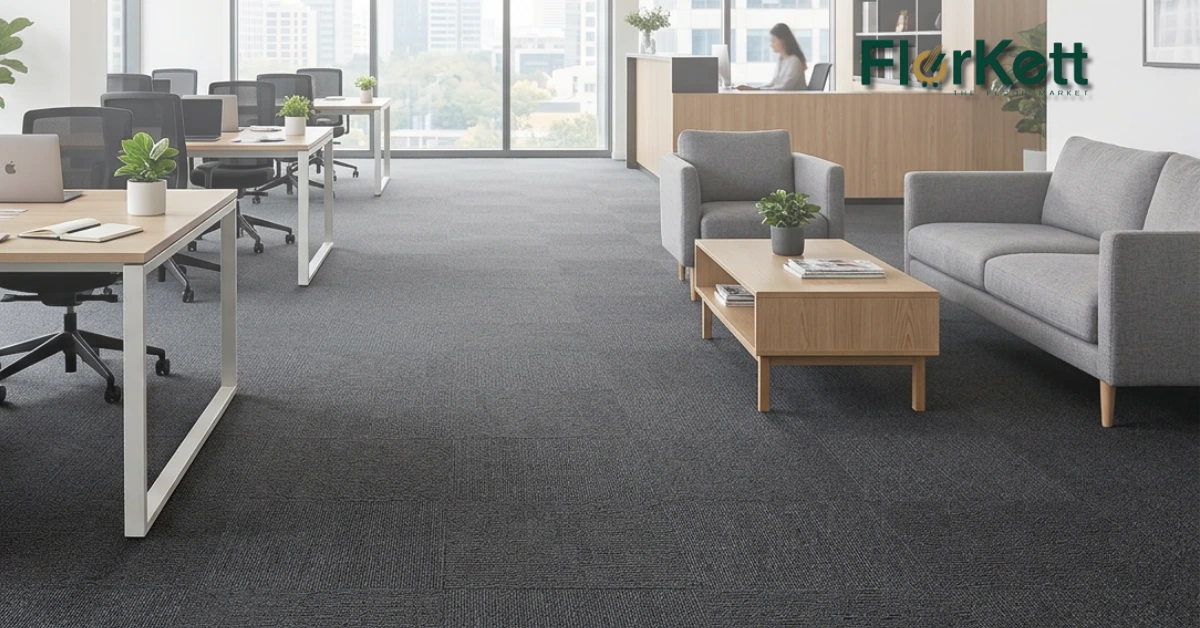


If you manage a commercial property in Dubai, whether it’s a corporate office in Business Bay, a school in Sharjah, or a retail showroom in Deira, you’ve almost certainly landed on the same shortlist: PP (polypropylene) carpet tiles or nylon carpet tiles. Both are modular, both come in the styles you need, and both are widely available across the UAE.
But choosing the wrong one is a costly mistake. We’ve seen facility managers lock in nylon for a warehouse floor, only to regret the spend within a year. We’ve also seen budget-focused buyers go full PP in a high-traffic hotel corridor and end up replacing worn tiles far sooner than expected.
This guide cuts through the noise with a direct, experience-backed comparison so you can make the right call for your specific space in 2026.
What’s the Real Difference Between PP and Nylon Carpet Tiles?
PP (polypropylene) carpet tiles are manufactured from synthetic olefin fibres, are lightweight, moisture-resistant, and cost-effective for moderate-use environments. Nylon tiles use polyamide fibres that are naturally more resilient, spring back faster under foot pressure, and outperform PP in high-traffic areas over a 5–10 year lifespan.
The fibre is everything. Polypropylene is a non-absorbent fibre; liquid sits on the surface rather than going inside the pile, which makes it excellent at resisting staining. Nylon, by contrast, absorbs marginally more, but modern solution-dyed nylon tiles have closed that gap significantly. What nylon maintains as its clear advantage is crush resistance: the ability of the pile to recover its shape after repeated compression from chairs, foot traffic, and heavy furniture.
In Dubai’s commercial landscape, where air-conditioned spaces run at high usage for 10–12 hours a day, pile recovery is what separates a floor that looks good in year one from a floor that still looks good in year five.
Cost Comparison: PP vs Nylon in the UAE Market
PP carpet tiles in Dubai typically range from AED 12–28 per tile (50×50 cm), while nylon carpet tiles run from AED 28–65 per tile for comparable grades. Over a 10-year lifecycle, the total cost of ownership often narrows, sometimes reverses when you factor in replacement frequency and maintenance labour.
Here’s where most buyers get it wrong: they calculate purchase cost, not lifecycle cost.
A 500 sqm office fitted with PP tiles at AED 18/tile might cost AED ~90,000 to supply and install. The same space in mid-grade nylon at AED 40/tile runs to approximately AED ~200,000. That’s a significant gap until you consider that PP tiles in a medium-traffic open-plan office typically need partial replacement every 4–5 years. Nylon? You’re looking at 8–12 years before any meaningful patchwork is needed.
The insider tip most suppliers won’t tell you: In Dubai’s climate specifically, UV exposure from floor-to-ceiling glazing (common in towers along Sheikh Zayed Road, DIFC, and Jumeirah Lake Towers) degrades polypropylene fibres faster than it does nylon. PP is more susceptible to UV-induced colour fading and fibre brittleness. If your space has significant natural light exposure, the real-world lifespan of PP tiles sometimes shortens dramatically.
Performance in Dubai’s Climate and Building Types
Dubai’s built environment creates specific demands that you won’t find addressed in generic carpet tile guides written for European or North American markets.
Heat and Air Conditioning
Commercial interiors here cycle between intense outdoor heat (40°C+ in summer) and aggressive air conditioning (often 18–22°C inside). This thermal cycling affects glue performance and tile dimensional stability. Both PP and nylon handle this reasonably well with modern bitumen or PVC backings, but nylon tiles with fibre-bonded backings show less edge curling over time, a real issue in spaces where tiles are laid without full adhesive coverage.
Humidity and Moisture
Coastal humidity in Dubai and Sharjah can affect subfloor conditions, particularly in ground-level retail spaces, basement car park transitions, and older building stock in areas like Bur Dubai and Al Nahda. Here, PP’s natural moisture resistance gives it a genuine edge. Polypropylene does not support mould growth, and its non-absorbent fibre structure means it dries faster if wet mopping is part of your cleaning protocol.
Static Electricity
This matters more than people assume. In low-humidity, heavily air-conditioned offices standard across Carpet Tiles Dubai commercial projects, static build-up can be a real operational problem, especially around IT equipment and data rooms. Nylon tiles are more prone to static generation; quality nylon tiles mitigate this with built-in anti-static treatments, but always confirm this specification before purchasing.
PP Carpet Tiles: Complete Advantages and Disadvantages
Advantages:
- Lower upfront cost better for budget-constrained projects, phased fit-outs, or short-lease commercial spaces
- Naturally stain-resistant and moisture-repellent, ideal for classrooms, canteens, and light retail
- Easier to source quickly across Dubai and Sharjah, with faster lead times
- Performs well in low-to-moderate foot traffic environments (below ~150 people/day in the space)
- Colour is solution-dyed into the fibre, making early-stage fade resistance good
Disadvantages:
- Lower crush recovery pile flattening is visible in chair paths and walkways within 2–3 years in busy spaces
- UV sensitivity in sun-exposed interiors accelerates fibre degradation
- Less suitable for luxury or executive environments where aesthetics must remain sharp long-term
- Total lifecycle cost can exceed nylon when replacement labour is accounted for
Nylon Carpet Tiles: Complete Advantages and Disadvantages
Advantages:
- Superior pile recovery and durability in high-traffic zones the industry benchmark for commercial flooring
- Wide design range, including cut pile, loop pile, and textured patterns for premium aesthetics.
- Better dimensional stability in varying humidity and temperature conditions
- Lower long-term maintenance cost in heavy-use environments
- Anti-static variants are widely available and critical for tech-heavy office environments
Disadvantages:
- Higher upfront investment, which can be a barrier for smaller projects or startups
- Some nylon grades require more careful stain treatment (particularly face-dyed, non-solution-dyed variants)
- Heavier tiles can slow installation slightly minor but relevant for large-scale projects on tight timelines
- Premium nylon tiles may require longer lead times for specific colours or patterns
Which Commercial Environments Should Choose Which?
This is where the decision really lands. Not every space has the same demands, and applying a one-size-fits-all rule leads to poor outcomes.
Choose PP Carpet Tiles if:
- Your space is a classroom, school corridor, or educational facility in Sharjah or Dubai with a limited refurbishment budget
- You’re fitting out short-term leased retail space (under 5 years), where ROI on nylon isn’t justifiable
- The area has moderate foot traffic and strong air conditioning, the sweet spot for polypropylene performance
- You’re managing a residential building lobby or shared area where aesthetics are secondary to easy cleaning
- Budget constraints are real and non-negotiable
Choose Nylon Carpet Tiles if:
- You’re fitting a corporate headquarters, executive office, or co-working space where the floor is a brand statement
- The space experiences more than 150–200 daily users in hotel lobbies, airport lounges, and busy retail flagships
- You need the floor to look and perform consistently for 8+ years without major intervention
- The area has significant glazing and natural light exposure (UV resilience is essential)
- You’re working on a hospitality project, hotels along Sheikh Zayed Road, JBR, or the Palm Jumeirah, where Flooring Dubai standards demand longevity and luxury aesthetics together
The Contrarian View: Stop Thinking in “Either/Or”
Here’s an approach we rarely see implemented but consistently recommend: hybrid zoning.
Most large commercial fit-outs in Dubai treat the entire floor plate the same. They shouldn’t. A 1,000 sqm office has high-traffic zones, reception, pantry, main walkways and low-traffic zones, private offices, meeting rooms, and storage areas.
Spec nylon for the 30% of the floor that takes 70% of the punishment. Use PP for everything else. You’ll cut your total flooring budget by 20–25% compared to going full nylon, while delivering a floor that performs and looks the same as a full-nylon installation for the first 7–8 years.
The key to making this work is colour and texture matching between the two tile types. Many suppliers in Dubai can colour-match PP and nylon tiles closely enough that the difference isn’t visible, but you need to ask for samples side by side before committing.
What to Ask Your Supplier Before You Buy
Before signing off on any carpet tile order, PP or nylon, these are the specifications that actually matter:
- Pile weight (g/m²): Higher is generally more durable. For commercial nylon, look for 500 g/m² and above. PP at 400 g/m² is solid for moderate use.
- Backing type: Bitumen-backed tiles are heavier and more stable. PVC-backed tiles are lighter and better in moisture-prone areas.
- Anti-static rating: If you’re in tech, finance, or healthcare, this is non-negotiable; confirm EN 1815 compliance.
- Dimensional stability: Tiles should conform to ISO 2551 for stability under temperature change.
- Fire rating: In the UAE, commercial spaces must meet BS 4790 or equivalent flammability standards. Confirm before purchase.
- Warranty: Quality nylon tiles carry 10–15 year commercial warranties. PP warranties typically run 5–7 years.
In Summary
PP and nylon carpet tiles serve genuinely different purposes. PP is not a “cheap nylon” it’s a different product category with its own legitimate strengths for the right application. Nylon is not an unnecessary luxury in the right environment; it’s the only sensible long-term investment.
In 2026, with Dubai’s commercial real estate sector expanding across new business districts and Sharjah’s industrial and educational zones continuing to grow, the demand for both tile types is rising. The facilities managers and interior consultants who make the best decisions aren’t the ones who always choose the most expensive option; they’re the ones who match the product to the performance requirement.