
Choosing the right flooring for a commercial space in Dubai isn’t just about looks; it’s about protecting your staff, your customers, and your business from liability. Over the years, we’ve walked into warehouses, hospitals, schools, and food processing units across the city and seen firsthand how the wrong flooring choice turns into a costly, dangerous mistake. This guide breaks down everything a facility manager, contractor, or business owner needs to know before investing in safety vinyl flooring.
What Is Safety Vinyl Flooring and Why Do Dubai Businesses Need It?
Direct Answer: Safety vinyl flooring is a slip-resistant, heavy-duty vinyl surface engineered with textured or aggregate-embedded finishes that meet international slip ratings. Dubai businesses need it due to strict fire codes, heavy foot traffic, AC condensation-related humidity, and Dubai Municipality requirements for commercial and healthcare facilities.
Unlike standard vinyl sheet flooring, safety vinyl incorporates carborundum or quartz particles into the wear layer, creating consistent grip even when the surface is wet, greasy, or covered in fine dust. This matters enormously in a climate like Dubai’s, where indoor humidity swings and constant air-conditioning condensation can leave tiled or polished concrete floors dangerously slick.
We’ve seen this play out repeatedly with clients across Vinyl Flooring Dubai projects: a commercial kitchen switches from ceramic tile to safety vinyl and insurance-reportable slip incidents drop to almost zero within the first quarter. That’s not a coincidence; it’s physics. The textured surface increases the coefficient of friction, and that single change significantly reduces liability exposure.
Common Dubai sectors that rely on safety vinyl include:
- Healthcare facilities: clinics, hospitals, dialysis centers
- Food & beverage: commercial kitchens, central kitchens, cold storage entry zones
- Industrial & warehousing: loading docks, production floors
- Education: labs, cafeterias, sports halls
- Hospitality: back-of-house kitchens, staff corridors
If you’re weighing safety vinyl against other Flooring Dubai options like epoxy or ceramic, the deciding factor usually comes down to one thing: where water, oil, or foot traffic converges.
Where Should You Install Safety Vinyl Flooring in Commercial Spaces?
Direct Answer: Install safety vinyl flooring in any zone where wet, greasy, or high-traffic conditions create slip risk: commercial kitchens, hospital wards, industrial walkways, changing rooms, and entrances exposed to rain or spillage. Prioritize transition zones between wet and dry areas first.
In practice, most commercial buildings don’t need safety vinyl everywhere. That’s a misconception we correct with clients constantly; it’s a targeted investment, not a blanket one. The zones that genuinely demand it are the ones where risk concentrates.
High-priority zones include:
- Commercial kitchen prep and cooking lines: grease and water are a constant presence
- Building entrances and lobbies: Dubai’s occasional heavy rain turns polished floors into hazards within minutes
- Hospital corridors, wards, and bathrooms: Patient mobility issues raise the stakes considerably
- Changing rooms and shower areas: In gyms, labor accommodation, or sports facilities
- Loading docks and warehouse aisles: Where forklifts, spills, and foot traffic intersect
A pattern we’ve noticed on walkthroughs: facility managers often flag the obvious wet areas but overlook transition zones the strip where a wet mop bucket gets wheeled from a kitchen into a dry dining area, for instance. These short stretches see disproportionate slip incidents because staff isn’t expecting a change in surface grip. When we advise clients, we always recommend extending safety vinyl coverage two to three meters beyond the “wet” boundary itself, not stopping exactly at the doorway.
How Much Does Safety Vinyl Flooring Cost in Dubai?
Direct Answer: Commercial safety vinyl flooring in Dubai typically ranges from AED 45 to AED 120 per square meter installed, depending on wear layer thickness, brand, and subfloor preparation needs. Healthcare-grade and heavy-duty industrial variants sit toward the higher end of that range.
Pricing isn’t one-size-fits-all, and any supplier quoting a flat rate without seeing your site is likely cutting corners somewhere. The variables that move the number most are:
- Wear layer thickness: 0.7 mm is standard commercial grade; 1.0mm+ suits heavy industrial or 24/7 traffic
- Subfloor condition: uneven concrete requires leveling compound, which adds cost
- Welding and coving: hospital-grade installations often need heat-welded seams and integrated wall coving for hygiene compliance
- Roll vs. tile format: rolls minimize seams (better for hygiene-sensitive spaces) but cost slightly more per square meter
- Brand origin: European manufacturers (Tarkett, Gerflor, Polyflor) generally command a premium over regional alternatives
One thing we tell every client upfront: the cheapest quote seldom accounts for proper subfloor prep. We’ve been called in to fix installations where vinyl was laid directly over uneven or moisture-affected concrete, and within eighteen months the seams had lifted. Budgeting an extra 10–15% for subfloor moisture testing and leveling saves far more in the long run than it costs.
What Safety Standards Should Commercial Vinyl Flooring Meet in the UAE?
Direct Answer: Commercial safety vinyl flooring Dubai should meet EN 13845 or DIN 51130 slip resistance ratings, achieve a minimum R10 rating for general commercial use, and comply with Dubai Civil Defence fire-rating requirements for flame spread and smoke toxicity.
Compliance isn’t optional, and it’s the area where we see the most confusion among first-time commercial buyers.
Slip Resistance Ratings (R-Ratings)
The German DIN 51130 ramp test assigns ratings from R9 (least slip-resistant) to R13 (maximum grip). For Dubai commercial use:
- R9–R10: dry retail and office corridors
- R10–R11: dining areas, general hospitality
- R11–R12: commercial kitchens, wet processing areas
- R12–R13: industrial zones with oil, grease, or heavy water exposure
Fire and Smoke Compliance
Dubai Civil Defence requires flooring in most commercial and high-rise buildings to carry a recognized fire rating, typically referencing EN 13501-1 classifications (Bfl-s1 being common for low smoke emission). Always request the manufacturer’s fire test certificate before procurement; this document is frequently requested during Dubai Municipality inspections.
Hygiene Certification
For healthcare and food facilities, look for vinyl certified to resist bacterial growth and support heat-welded, coved installation that eliminates dirt-trapping seams.
How Do You Choose the Right Safety Vinyl Flooring for Your Business?
Direct Answer: Choose safety vinyl flooring by matching the R-rating to your actual traffic and moisture conditions, verifying wear layer thickness against expected footfall, and confirming the product carries valid UAE fire and slip certifications before signing off on any supplier quote.
We approach every client selection the same way: start with the risk, not the catalog. A gym changing room and a warehouse loading dock both need “safety vinyl,” but the right product for each looks completely different.
Our practical selection checklist:
- Match the R-rating to real conditions; don’t over-spec R13 for a dry office corridor; it wastes budget and can feel uncomfortably rough underfoot
- Check wear layer thickness against footfall; high-traffic corridors need 0.7mm minimum; ultra-high traffic (hospitals, airports) benefit from 1.0mm+
- Confirm chemical resistance if the space handles cleaning agents, oils, or pharmaceuticals
- Ask for slip-rating test certificates, not just marketing claims; reputable suppliers provide these without hesitation
- Consider acoustic and comfort needs; healthcare and education spaces often benefit from cushioned-backing vinyl that reduces noise and fatigue
- Verify color and pattern availability in slip-resistant ranges, since not every decorative finish comes in a certified safety variant
A mistake we see often: businesses select a beautiful decorative vinyl first, then try to retrofit safety features onto it. It should always be the reverse: start with the certified safety range, then choose from the colors and finishes available within it.
What Is the Installation Process for Commercial Safety Vinyl Flooring?
Direct Answer: Professional installation involves subfloor moisture testing, leveling compound application, vinyl adhesion using approved commercial adhesives, and heat-welding seams for hygiene-critical spaces. A typical mid-sized commercial installation takes three to seven days depending on square footage and preparation needs.
Installation quality determines whether safety vinyl performs for ten years or fails within two. The process we follow, and recommend to any contractor, runs through several non-negotiable stages:
- Moisture testing: Dubai’s high ambient humidity makes this critical; installing over a damp slab causes bubbling and adhesive failure
- Subfloor leveling: self-leveling compound corrects dips and high spots before vinyl goes down
- Acclimatization: vinyl rolls need to adjust to room temperature and humidity for 24–48 hours before laying
- Adhesive application using manufacturer-approved commercial-grade adhesive, applied with the correct trowel notch size
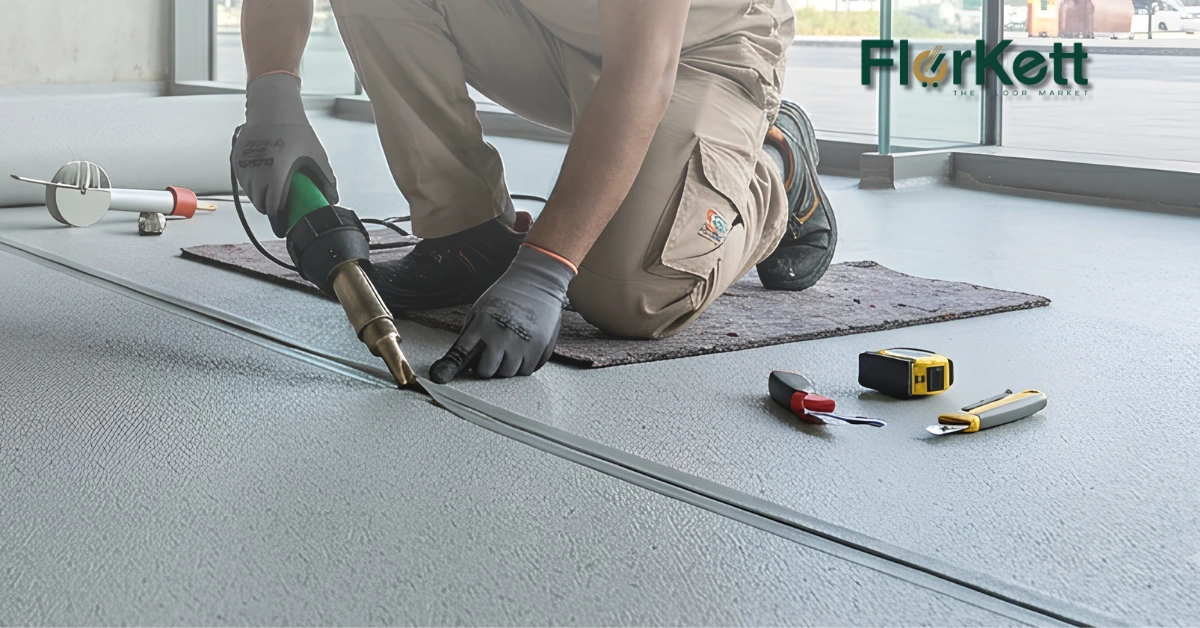
- Seam welding: hot-air welding fuses seams into a single, waterproof surface, essential for kitchens and clinical areas
- Coving: wall-to-floor coving eliminates 90-degree corners where bacteria and moisture typically collect
Businesses that stay operational during installation should plan for phased work, sectioning off zones so daily operations continue with minimal disruption. We’ve coordinated overnight installations for 24-hour facilities more than once, and the key is always sequencing: prep one zone while adhesive cures in another.
How Do You Maintain Safety Vinyl Flooring for Long-Term Durability?
Direct Answer: Maintain safety vinyl flooring with daily dust mopping, weekly deep cleaning using pH-neutral cleaners, and periodic deep-scrub-and-reseal treatments every six to twelve months. Avoid abrasive pads or high-pH chemicals, which strip the textured wear layer and reduce slip resistance over time.
Safety vinyl’s grip comes from its textured surface, and that texture is exactly what deteriorates first if maintenance is done incorrectly. We’ve inspected floors that looked “clean” but had lost most of their slip resistance simply because staff used the wrong cleaning products for years.
Maintenance best practices:
- Daily: dust mop or vacuum to remove grit that acts like sandpaper under foot traffic
- Weekly: damp mop with a pH-neutral, non-oil-based cleaner formulated for safety vinyl
- Avoid: wax-based polishes, which fill in the textured surface and eliminate grip entirely
- Avoid: bleach and high-alkaline cleaners, which accelerate plasticizer breakdown and cause brittleness
- Periodic deep clean: mechanical scrubbing with a soft pad, followed by manufacturer-recommended resealing every 6–12 months in high-traffic commercial settings
Facilities that follow this routine consistently get 10–15 years of service life from a properly installed safety vinyl floor, compared to as little as three to five years for floors maintained with generic janitorial products. It’s a small operational discipline with an outsized return.
Frequently Asked Questions
Is safety vinyl flooring suitable for outdoor use in Dubai?
Standard safety vinyl is designed for indoor use. For semi-outdoor or covered areas exposed to direct sun, UV-stabilized formulations are required to prevent fading and brittleness.
Can safety vinyl be installed over existing tile?
Yes, in most cases, provided the tile surface is sound, level, and properly primed. A qualified installer should assess the substrate first.
How long does safety vinyl flooring last in high-traffic commercial spaces?
With proper installation and maintenance, commercial-grade safety vinyl typically lasts 10–15 years, even in demanding environments like commercial kitchens and hospital corridors.
Getting safety vinyl flooring right in Dubai comes down to matching the product’s certified slip rating to your actual risk zones, insisting on proper installation and subfloor preparation, and committing to a maintenance routine that protects the wear layer rather than degrading it. Get those three things right, and the floor stops being a liability and starts being one less thing you have to think about.